What did people look like in bible times?
Not like the paintings. The Renaissance gave the biblical world European faces and velvet robes; the real first-century Galilee was wool tunics, work-worn hands, and Mediterranean sun.
Ordinary people of the biblical era were Mediterranean and Near Eastern in appearance: olive-to-brown skin, dark hair, and practical dress. Most wore a simple knee- or ankle-length wool or linen tunic with a cloak, a belt, and sandals; head coverings were common for both sexes. HolyShot lets you see it firsthand by placing your own face, as an ordinary person, into historically grounded scenes from nine eras.
The everyday look of the first century
Start with the basics scholars broadly agree on. The staple garment across the region was the tunic: a simple woven rectangle of wool or linen, belted at the waist, knee-length for labor and longer for dignity. Over it went the cloak, which doubled as a blanket and was valuable enough that lending law mentions it. Sandals of leather, a head covering against the sun, and for most people exactly one change of clothes. Dyes were costly, so everyday cloth ran the spectrum of undyed wool: cream, brown, gray, with color reserved for trim and the wealthy.
Faces and features
Galilee, Judea, and the wider Near East were home to Mediterranean peoples: dark hair, brown eyes, olive-to-brown skin weathered by outdoor life. Forensic reconstructions of first-century remains suggest average heights around five feet five for men, shorter for women, with sturdy builds shaped by physical work. Hair was typically kept shorter than the paintings suggest for men, and covered or braided for women. The flowing-locked, fair-skinned figures of European art say more about the painters' neighbors than about Galilee.
Why the paintings got it wrong
Renaissance artists painted the biblical world with the faces, fabrics, and architecture they could see out the window, partly from ignorance and partly by design: making the story local made it immediate. The result is centuries of beautiful, deeply inaccurate imagery that still shapes how we picture the era. Getting it righter does not diminish the story; if anything, wool and dust and sun make it more human.
See it on your own face
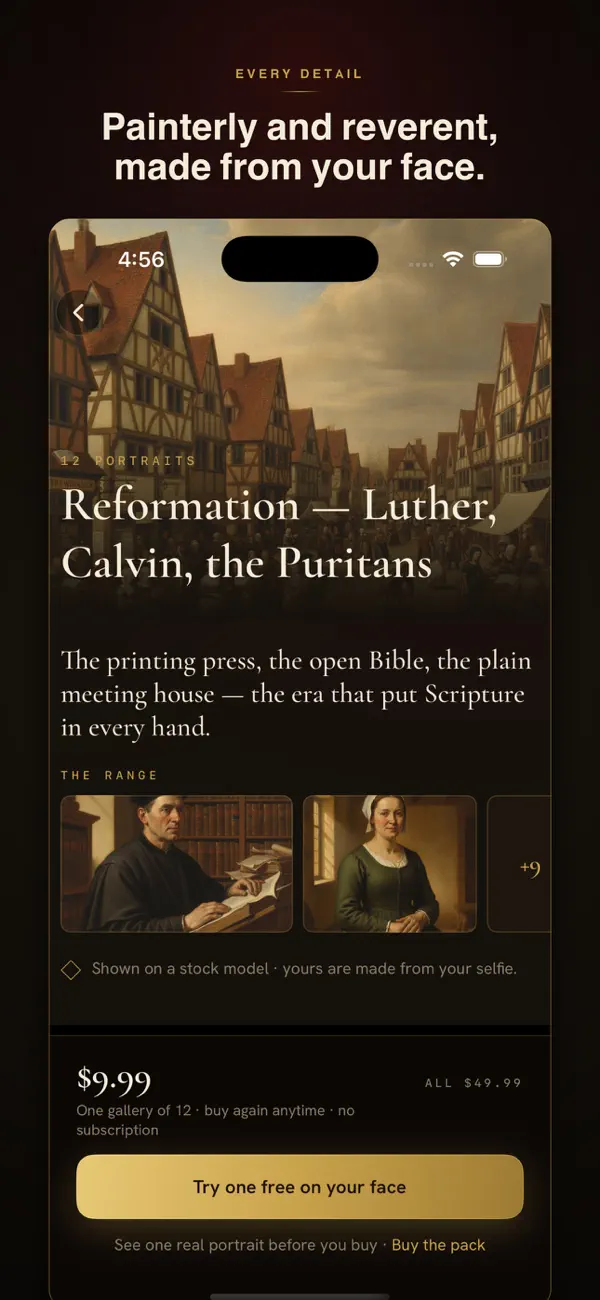
Reading about tunics is one thing. Seeing yourself wearing one on a Galilean shoreline is another, and that is what HolyShot is for. One selfie generates twelve portraits of you as an ordinary, unnamed person of the era: a fisherman, a market seller, a traveler. The scenes are grounded in the period's real dress and light, and the app never depicts you as Jesus, God, or any named figure, only as one of the everyday people the paintings forgot.
- Download HolyShot and open the First-Century or Ancient Hebrew pack.
- Take the free first look on your own face.
- Compare your portrait to the paintings you grew up with. The differences are the history lesson.
Frequently asked questions
Is HolyShot historically accurate?
The scenes are grounded in each era's real dress, settings, and light, rendered in a classical-art style. They are respectful artistic portraits, not archaeological documents.
Does it show biblical figures?
No. HolyShot only depicts you as an ordinary, unnamed person of the era. Jesus, God, and all named or holy figures are never generated, by design.
See yourself in the story.
HolyShot is free to download, with a free first look on your own face before you ever buy. One-time packs, no subscription.